


‘Here, sign this NDA. We’ll meet at [redacted] coordinates at 8am in the morning. I’ll be in a grey Toyota Yaris.’ These are the sorts of instructions preceding one’s own gory murder, the initiation to some venereal cult, or an exchange of Class A drugs. Not, you might expect, the use of a dog to find and dig rare fungi out the ground.
But here we are. In a woodland in west Wiltshire, no less, with Winnie the four-year-old cocker spaniel, her handler Dan, and his partner Becky. Winnie is a UK Truffle Dog Champion (2023), and she’s about to demonstrate her talents.
Wiltshire, obviously, isn’t Italy’s Piedmont or France’s Périgord. But, like those regions, much of the county sits on limestone – alkaline soils generally being, like the roots of oak, beech, lime, and hazelnut trees, where the formation of truffles occur. “I think that’s the hardest thing,” says Dan, keeping an eye on Winnie and her propensity to bolt off at any given moment to dig up and – unless he’s quick enough – chow down a black truffle. “We’ll be travelling for hours and hours just looking for the right places. You’ve got to look at the way the woodland’s facing, the drainage, how dense it is. And then the types of trees – there’s quite a few beech trees here, so they [truffles] grow quite well.”
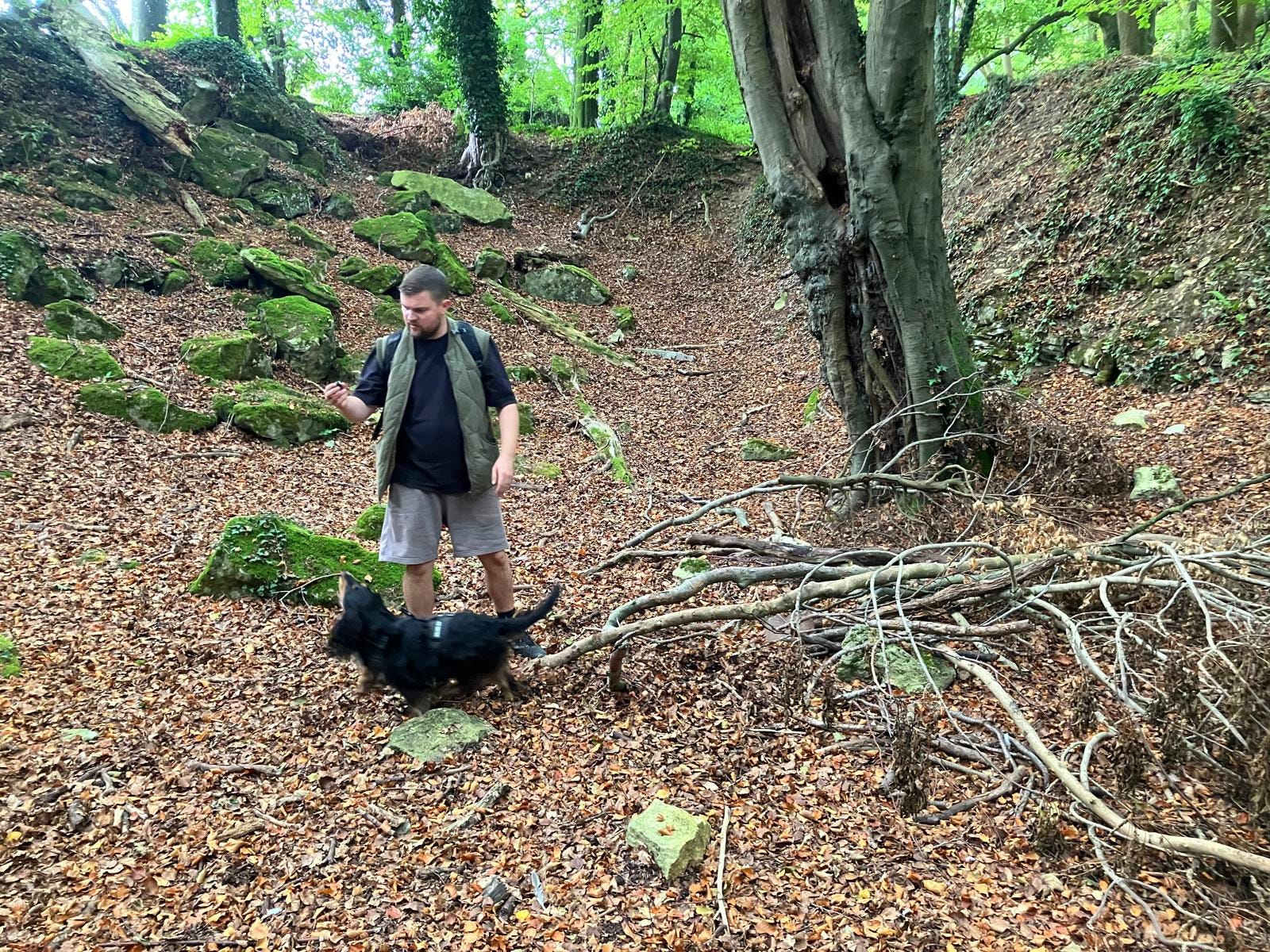
‘Here’ is a closely guarded secret – hence the NDA – not out of the kind of necessity you may find in Italy (which has its black markets, dog poisonings, and dog kidnappings), but more out of a want to keep the woodland intact. “We’ve had a few instances where people have brought massive groups to hunt with their dogs and sell [what they find] commercially and that’s it,” Dan says. “It destroys the area.” Extensive harvesting of wild garlic, mushrooms, nuts, berries, and herbs is more and more a problem in the UK, compromising soil structures and ecosystems to a degree that areas such as the New Forest now have ‘no foraging’ policies for certain plants and fungi – truffles included.
That leaves those off the list of best places for truffling in the UK then – a list which includes The South Downs, Cotswolds, Dorset, and Hampshire. Still, arguably the best spot for truffles is Wiltshire, “where you’ve got a lot of bigger woodlands,” says Dan. Since we’re in such a woodland, truffles could be just about anywhere inches under the forest floor. Mind you, a lack of sunlight – symptomatic of a too dense canopy – means a less healthy woodland, which means less of a likelihood for truffles. “Back in the day, when they were doing really well in Wiltshire, is when they used to do all the coppicing,” Dan says. “No one really manages a lot of these woodlands now, making them not great.”
Also back in the day, nowhere was more famous for its truffles in the UK than the parish of Winterslow, near Salisbury. Its ancient woodland would suggest why. At its peak, there were a dozen professional truffle hunters in the area. Alfed Collins was one of them, he and Major (his terrier/poodle cross) being the UK’s last solely dedicated truffle hunters in the UK up until their retirement in the 1930s.
As for our modern day hunters: within ten minutes of entering the wood, Winnie’s caught a scent. She darts off, then circles an unassuming area a short ways off the footpath. She claws out a shallow hole, unearthing a dark, rough, marble-sized truffle. Dan gets in there before her mouth does and hands it over. It feels dense, dry, and scaley, as if dinosaur skin. It has a pungent, boot polish-like smell. Not long later, Winnie – the unyielding desire to closely cover every inch of ground bred into her – brings up another, and another, and another. Some are the bagnoli variety, some Autumn truffles.
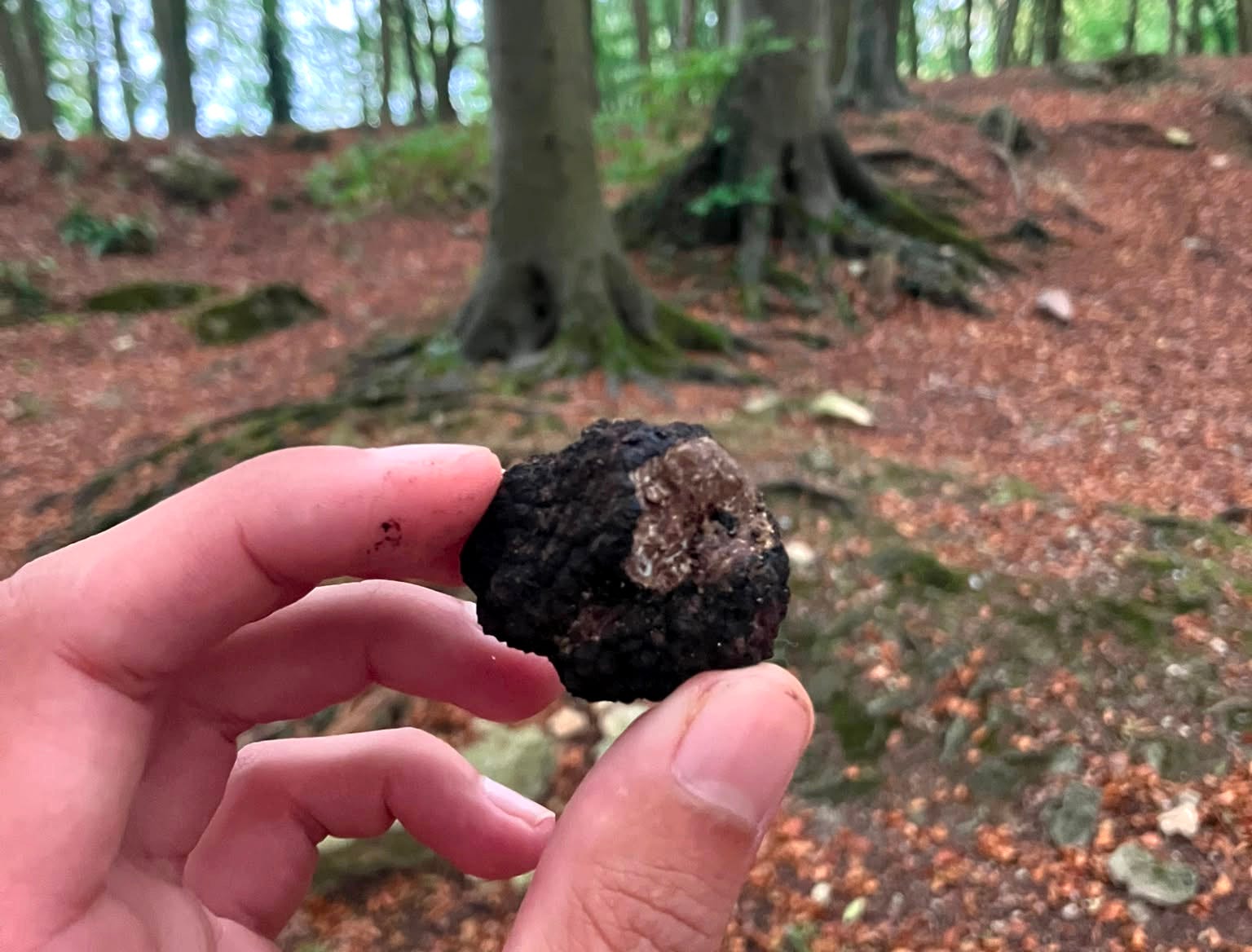
Over the next couple of hours, Winnie has found us about 120 grams of black truffle. Which, if it was to find its way onto the market, could fetch around £140. Instead, they’ll make their way home, microplaned into some leftover squash risotto destined for arancini, and, later, combined with half a kilo of butter for safe keeping and spreading on toast and having in scrambled eggs and mashed potatoes and more or less anything and everything else.
120 grams is somewhere around a morning’s average harvest. Though Dan says he’s found five kilos in one go before, bigger hauls are reducing because of extraordinarily dry summers – as subterranean organisms without their own roots, truffles suffer more in periods of drought than woodland flora above ground, to the point where cultivated truffle orchards (taking a decade or so to mature) are looking more and more like a valid proposition, for better or worse.
In the meantime, enthusiasts have come down the country, or even from parts of continental Europe, to go truffle hunting in Wiltshire and Somerset woods (Dan says he’s had folks from as far as Sheffield or even Germany). For them, truffles are tied into the culinary geography of the area. Or should that be culinary geology, seeing as – similar to snails and Mendip wallfish – the limestone-rich soils of this part of the country are, partly, defining what the land wants to give. Visitors might be cottoning on to what truffles say about the region, but among a lot of contemporary locals – this one included – that’s taking a fair bit longer to realise.
Great storytelling. Got lost in that. Bravo.