


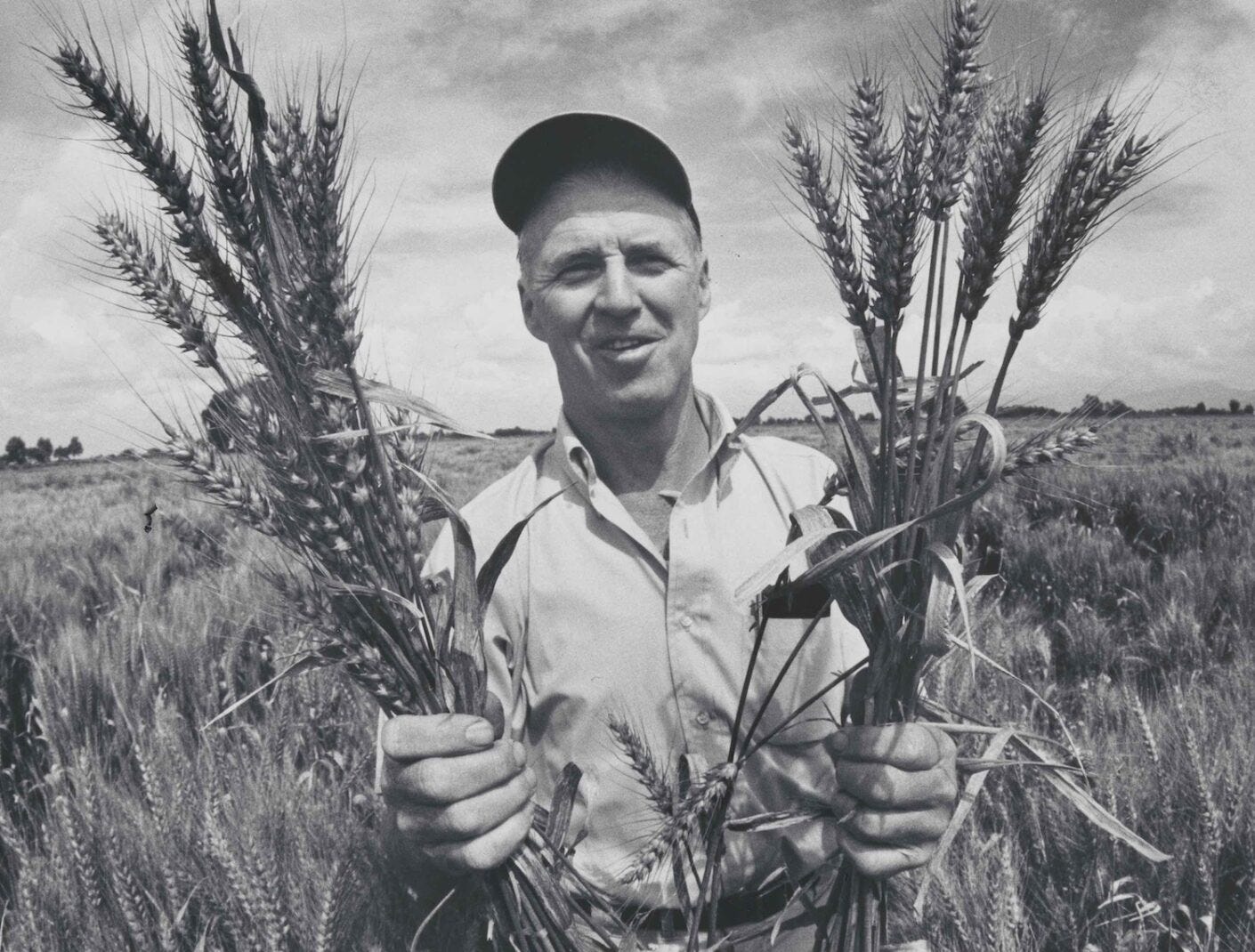
Since the late ‘60s, Norman Borlaug has been known as the man who saved more lives than anyone had before. At least, that’s what his biggest fans say. After WWII, as Boomers will tell you, world population doubled within 30 years. Food supply simply wasn’t going to keep up, and hundreds of millions of people were in danger of becoming food insecure or subject to famine. But Borlaug, who headed up a team of wheat breeders in Mexico, had an idea.
If you walked through a field of wheat 80 years ago, crops would come up to at least chest height. Generally, this was a good thing, as the wheat outcompeted neighbouring weeds for sunlight. But Borlaug saw a problem – the plants were putting too much energy into their roots and stems, and not enough into their grain.1 Through the process of selective breeding, and in an around-the-clock manner, Borlaug came up with what we have now – a dwarf wheat that, due to the increased energy directed towards its seedheads, could produce two to three times the yields farmers were getting before.
Almost every field of wheat in the world, their stems only reaching one’s knee, is a reminder of Borlaug’s legacy – a legacy that includes whole continents or countries (like Bangladesh, Pakistan, and India) averting famine, even to the point of accumulating surplus and achieving new wealth from exporting grain.
“More than fifty percent of the total world population live in poverty, with hunger as a constant companion and fear of famine a continual menace”
— Norman Borlaug
Of course, all this was going to have some trade-offs. Though of little concern at the time, Borlaug’s wheat varieties depended on synthetic fertiliser to produce plump seed heads; irrigation to help with the heightened volumes of water demanded; pesticides, herbicides, and fungicides to control the various infestations of these new monocultured fields; and mechanisation (tractors, combine harvesters, etc) to maximise input without dramatically increasing labour costs.
All fairly minor inconveniences, one might think, given the world was otherwise facing catastrophe (some experts estimate a billion or more dead were likely, most from starvation).2 But their effects – slow and creeping at first – are now firmly being felt. Chemical inputs so important to Borlaug’s system created nutrient imbalances, leading to soils that struggle to sustain the life we ask of it (and wild life more generally). Agrochemical production – still not fully recognised as a significant greenhouse gas emitter – now competes with the planet’s entire aviation industry in terms of carbon discharge. Large fields of single-species crops strain soils and are severely vulnerable to pests and disease. Making way for machinery has stripped the land of important wildlife habitats such as trees and hedgerows. Pesticides not only significantly contribute to the alarming decrease in biodiversity (including a 60% drop in UK flying insect numbers over the last two decades), but have been linked to various human health problems such as cancers, diabetes, and leukaemia.
There are also untold amounts of psychological, cultural, and socio-economic casualties of Borlaug’s mission, such as the devaluation of food (easily noticeable in post-war Britain), the transition of food and food production from people and community to corporate control (i.e. the antithesis of food sovereignty), and the general pursuit of yield over flavour. More tangibly of late, these agricultural methods are significant contributors to a dry, warming planet (ergo heatwaves, drought) whose soil health – therefore health of its food and therefore of its people – is also in decline as a result.
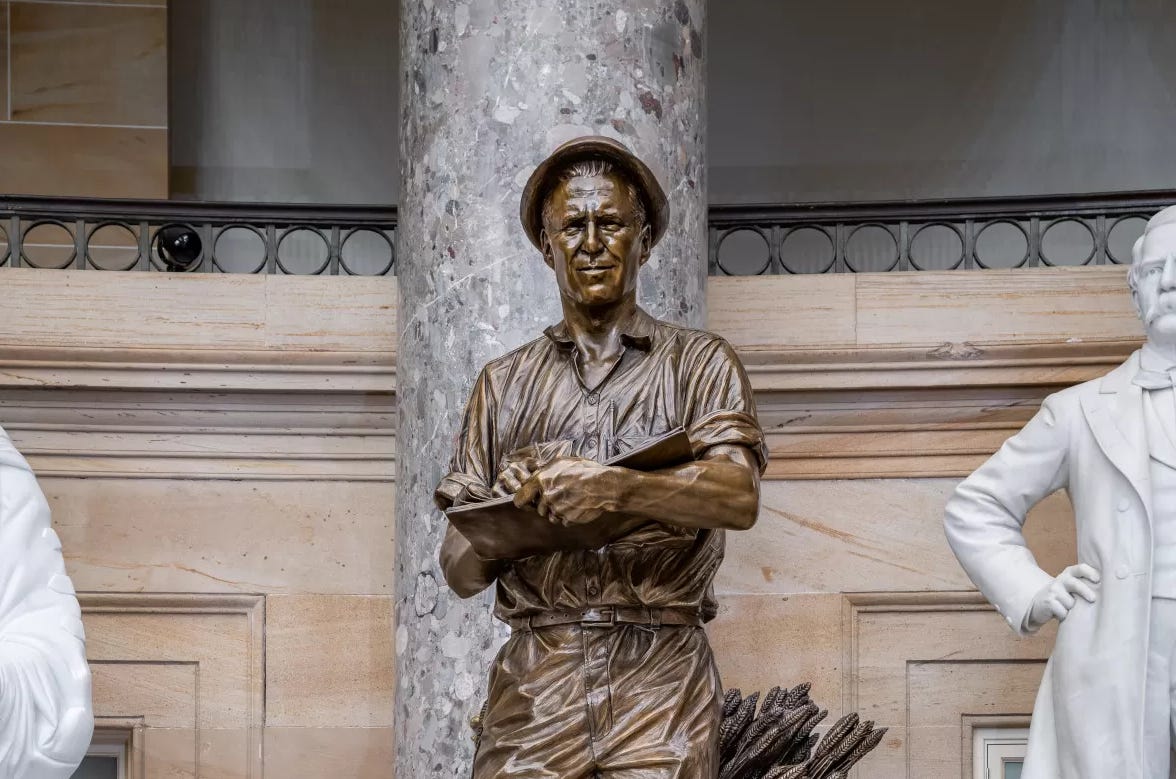
In spite of all, Borlaug – who died in 2009 – never regretted what the US government coined this ‘Green Revolution’. His hypothesis, for instance, included the notion that maximising yields disincentivised the destruction of woodland and other important ecosystems for new growing spaces (on the basis that yield would be higher per acre), and that GMOs were not an issue for their chemical-dependency, but a means to lift poorer countries out of poverty. Borlaug was also highly critical of organic food, and thought plants and soils reacted no differently to synthetic nitrogen fertiliser than organic fertiliser (for the record: they do).
Borlaug was more concerned about the constant need to feed an ever-growing population. But he of all people should have known – food surplus begets more people which begets the need for more food. And, though more green revolutions could arguably fulfil those needs, all systems built on the dictum of infinite growth inevitably collapse after they reach critical mass. Besides, much of the issue now is not in food production but that 30% of all food produced is either lost or wasted. And that commodity mindsets aroused from vast surplus have brought about the perverse phenomenon of cash crops grown in poor, food insecure countries to sell to already food secure ones.
Nevertheless, the green revolution’s second coming has been touted, by those including self-made agronomist Bill Gates, as what’s needed to fix the world’s declining ability to feed itself once again. Are there alternative ideas to what would surely be another exercise in industrial, corporate, and tech-driven problem solving that might come to save your life, but also might give you chronic disease, poison soils and waterways, and further enshittify food in general?
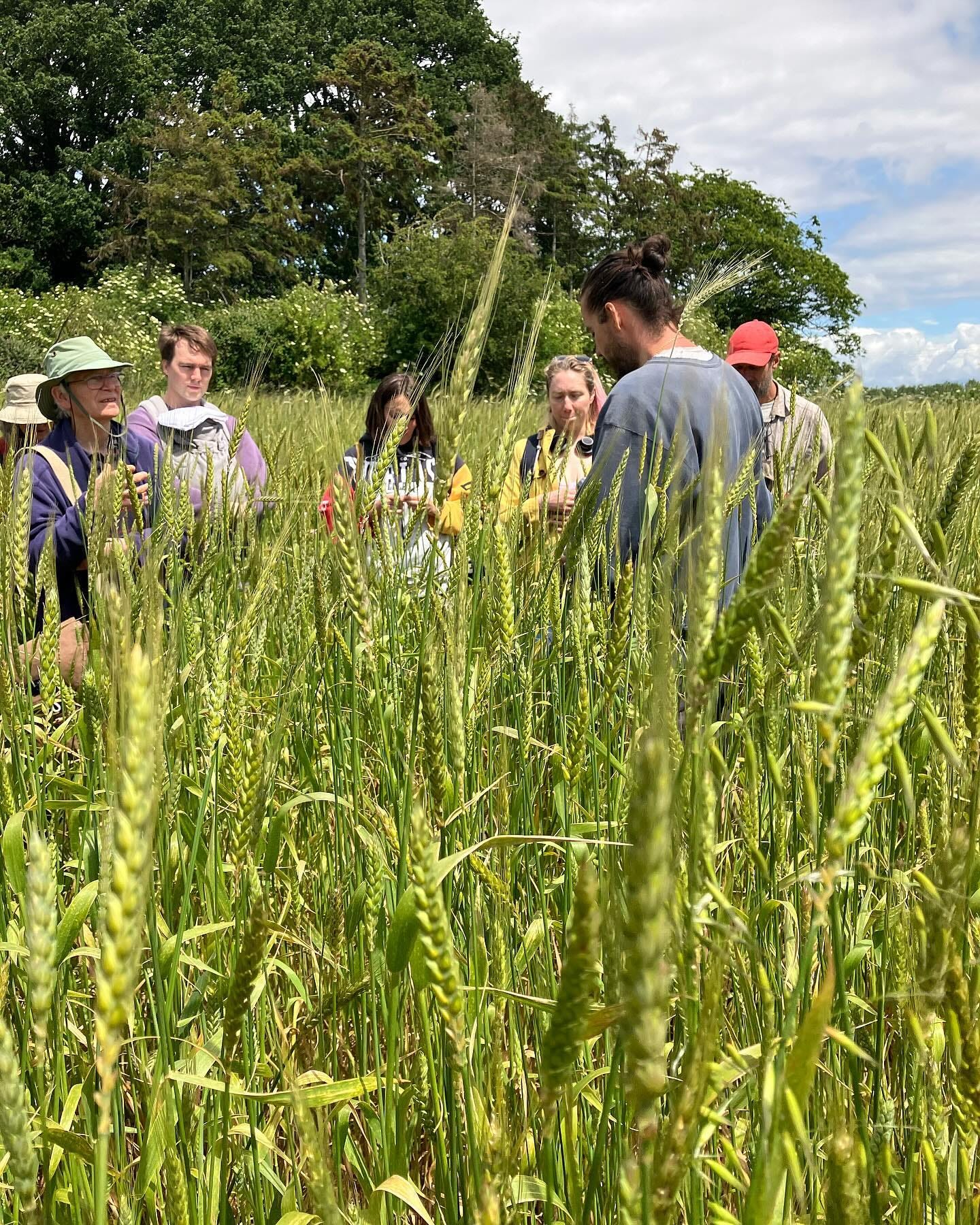
Yes, as it happens. And, as we’re talking about wheat, possibly the best example is right here in Somerset at Gothelney Farm – what I, for what it’s worth, perceive as the nucleus for the non-commodity grain network that exists in the region. This South West Grain Network is where growers, plant breeders, millers, bakers – among others – collaboratively eschew the high-input methods Borlaug pioneered in favour of things like flavour, nutrient density, resilience, fair prices for farmers, and nature restoration. What this entails is, by and large, a return to the past – traditional stone mills instead of roller mills, chest-high wheat instead of dwarf, and springy flavour-forward loaves instead of the industrialised pap we tend to find on supermarket shelves.
Are such things likely to stave off further famines and population crises? Gothelney’s wheat fields produce up to four tonnes per hectare (consistent with other regenerative farms), compared with the ten-tonne average for conventionally grown wheat in the UK. Cumulatively, that’s not enough to feed the world. But if the system was to be rewired into something that eliminated food waste, made efficient use of certain crops rather than as livestock feed, and improved soil health rather than degrading it, perhaps the answer would be much different. A study published last month, for instance, reckons that 70 million more people could be fed if human-made soil damage was curtailed by just 10%.
The more I read or hear about ‘innovation’, the more I’m convinced it’s not the positive word we tend to think it is. New technology might represent cutting-edge breakthroughs and broad societal progress to some, but, to paraphrase philosopher Marshall McLuhan, for every advantage a new tech offers, it also takes something away. You could point to social media for stunting our proficiency at in-person interaction, or how travel afforded by the combustion engine affects personal health and community cohesion. Innovations, such as Borlaug’s grand revolution, might actually reveal that many solutions to current and upcoming planetary crises do not reside in the future, but rather the past.
“We will be guilty of criminal negligence, without extenuation, if we permit future famines”
— Norman Borlaug
Borlaug was not wholly responsible for innovations in wheat at the time, but someone had to win the 1970 Nobel Peace prize, and there was arguably no better single candidate. For the sake of a good/coherent story, I apply the same logic here
Other sources, like Borlaug’s obituarist, actually suggest his methods ultimately facilitated more food poverty than they addressed