


What, we should be asking, is going on with British wine right now? 70 or so years ago, there was one vineyard in the UK. Now, there’s more than 1,100. It is, supposedly, the fastest growing wine region on the planet – despite, even, an abnormally high tax rate on winemakers (who have little choice but to pass that onto their customers), capricious growing conditions, and the still lingering stereotypes of English wine being synonymous with sparkly, boring wine.
To try make sense of it – and what it means within this little part of the country – are David Bailey, co-owner of Somerset’s oldest vineyard (52 years and counting) and Adam Collins, Somerset’s newest winemaker. Though the newness is technically true – his winery Saddle Goose opened in Frome 13 months ago – Adam’s also spent the last decade or so making or learning to make wine in France, Portugal, Chile, New Zealand, Buckinghamshire, and Essex, among others. “But I always felt like I was drawn to the South West more,” he says. “The vineyards round here are smaller and more eclectic than the huge, generic, and conventional production of the South East.”
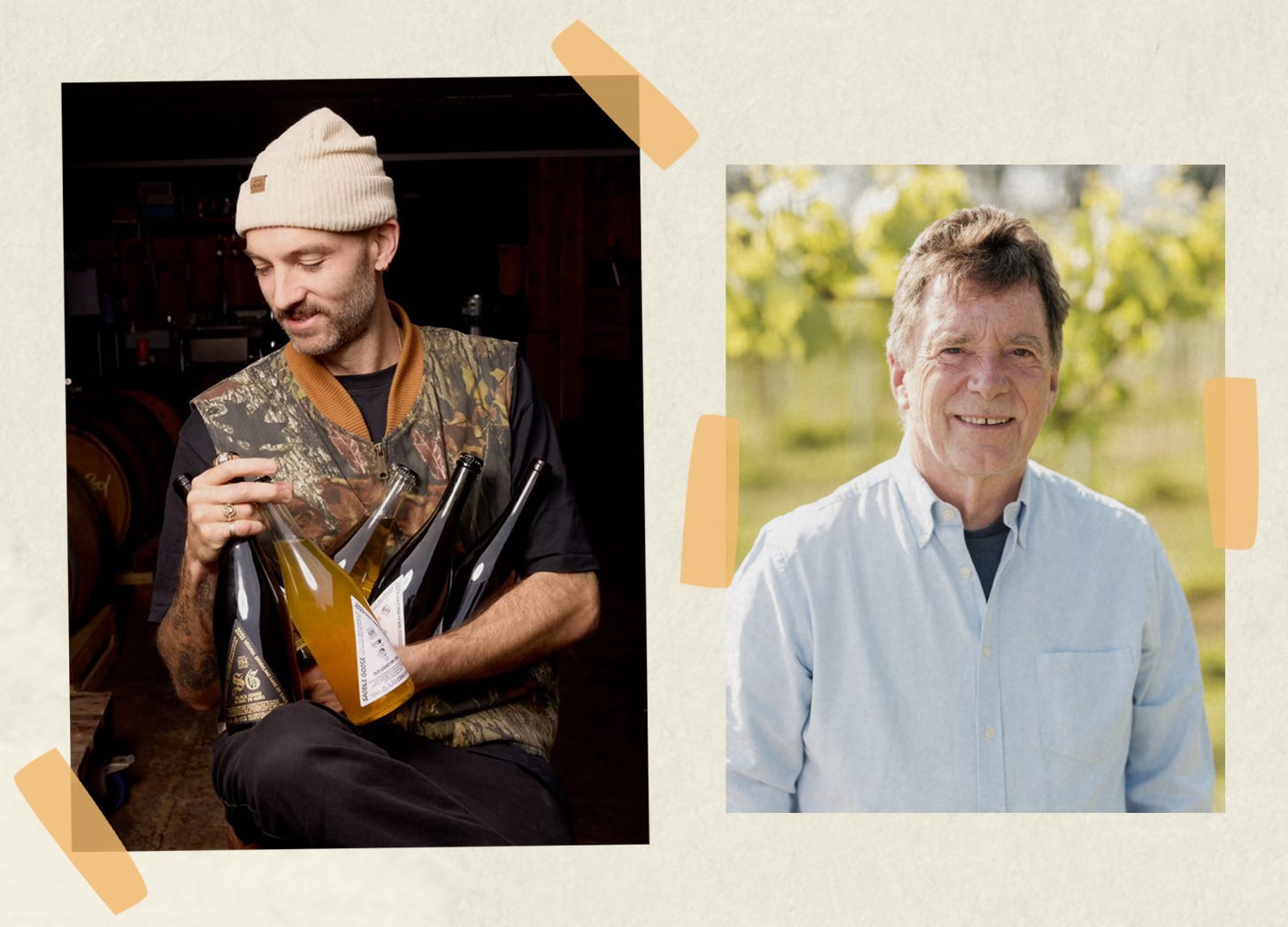
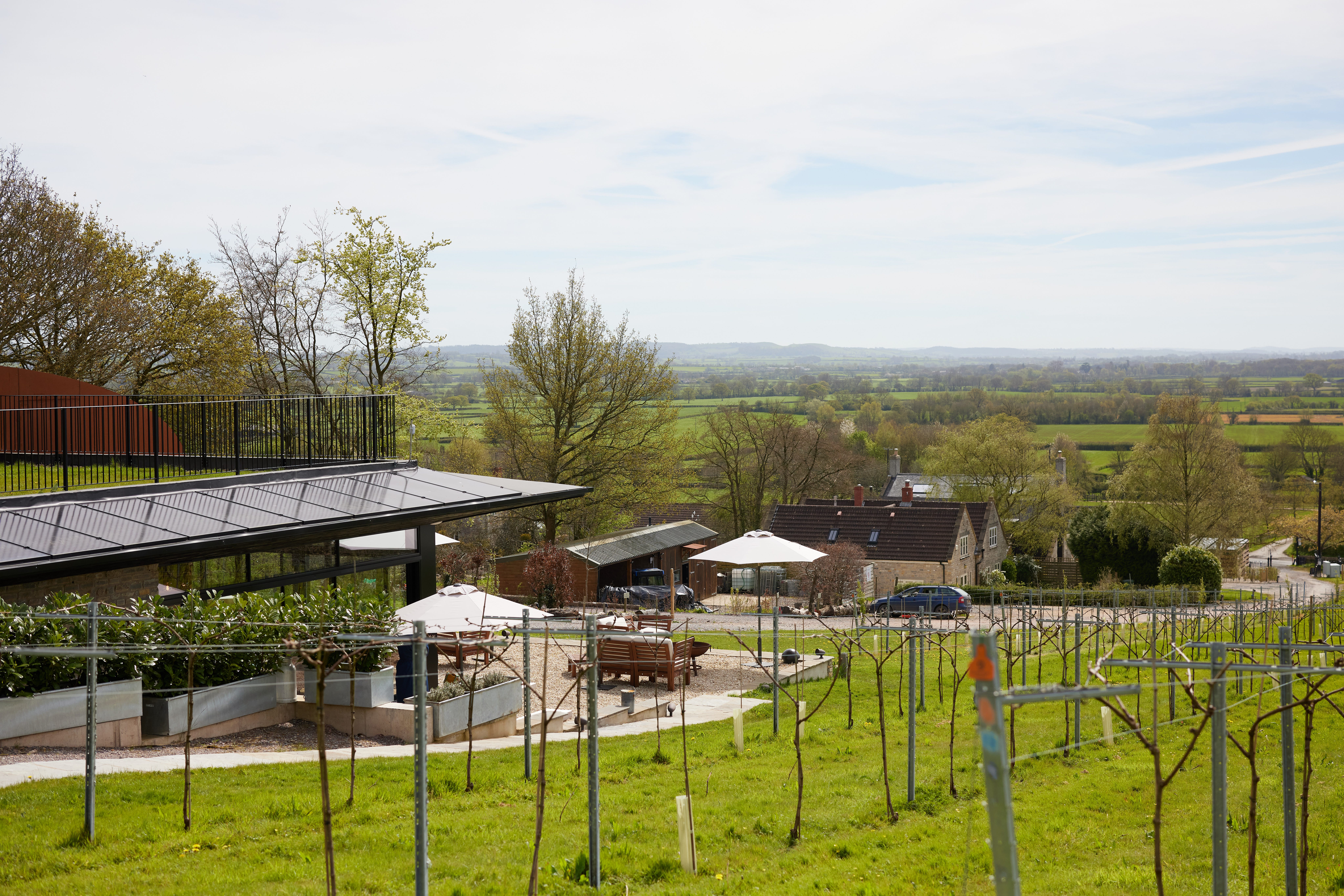
David and wife Lexa, meanwhile, have been firmly in the world of wine since they bought Wraxall Vineyard 2021. “In that year,” David says, “we had about 600 people ring up and say, ‘Can we do a tour and tasting?’ We said, ‘Well, okay. Give us five minutes and we’ll learn something about it first.’” In 2025, David and Lexa had 12,500 visitors to the vineyard, and this year are expecting 18,000.
There are at least 11 wineries in Somerset, which includes vineyards contracting out the making of their wine, as David does with Hampshire-based Itasca, and winemakers – like Adam – sourcing grapes from elsewhere. They all vary also in how they select their grapes (Adam only from regenerative growers such as Coombe Hay outside Bath and Avonleigh Orchards near Bradford-on-Avon), how they ferment their wine (David’s winemakers use a stock yeast which offers cleaner flavours, while Adam prefers the complexity of wild yeasts from their local natural environments), and starting price per bottle (Wraxall: £18, Saddle Goose: £25).
In that sense, the following dialogue is between a more traditional wine producer and one much less so; both providing some sort of expression of the locality whether via their own grapes (David), or yeast cultures from the land (Adam). Conversation took place around an upturned wine barrel at Saddle Goose’s cellar door in Frome, and is presented here edited for clarity and brevity.
Hugh: Would either of you say there’s a particular character about wine in Somerset or the South West? I mean, thinking about the wet albeit lush climate, or the soil type we have down here – which tends to be quite clayey, right?
Adam: Clay holds water better, which means it also holds nutrients better, which benefits some root stocks and some vines prefer it. But you want heat for that. In the future, if it continues to get warmer, I think Somerset soils will be brilliant especially for still wines. Then we can be more selective on grape types and clones – like Burgundy-style – that will do brilliantly here. Because in all of the UK, apart from probably the Crouch Vale [in Essex] and a couple of other places, we’re a marginal climate still – we just had frost recently, which can wipe out a percentage of your growth.
David: A lot of people are being frosted.
Adam: Yeah, because a lot of people planted in the wrong places. We’re still learning where’s the best plot. I say it’s less about soil type in England. It’s so much more important to get your aspect [a slope’s orientation in relation to sunlight] and your altitude, because if you’re not on at least a bit of a slope, you’re probably going to have some issues.
David: There’s a vineyard in Essex that went down to minus four [°C] and lost everything.
Adam: I read a study looking at the amount of money you have to pay to protect against frost, because it’s in the middle of the night with labour, candles, sprays, heaters, fans. What you can spend protecting it versus the average of what’s lost to frost – it actually works out about the same cost. Which is why, again, site is so important. If you’re on a slope, near some water that draws frost down the hill, the frost won’t stay.
David: We’re south-facing on a hill and you’re absolutely right, but our vines are high up as well, so the frost rolls under the vines and you see it go down the hill and it goes over the fields. You never can tell from historic records on vineyards, but rumour has it Wraxall’s never been frosted. And this year we got down to plus 1.9°C and that was our lowest.
Hugh: I’m guessing the frosts are likely to change with the changing climate?
David: We don’t quite know where it’s going. I mean, I don’t know what your vines are like, but ours are about a month ahead of where they were in previous years.
Adam: Warmth helps, but if they warm and come out too early, you can still get the risk of frost. So everyone is going, woah, last year was the earliest we’ve seen, and now this year was even earlier. But then we all go, hang on a minute, if frost comes along, we can still all be fucked.
David: You see what’s going on in Spain and Portugal with the heat and the lack of water, the fact that we’ve got clay and it retains moisture. Vines will go down about seven metres. We have wet, wet winters – what, three months of rain every single day. Everything is soaked into that clay. It’s all down there. They’ll go find it.
Hugh: Does that say something about the unpredictability with extreme weather events? Do they make you a bit more anxious?
Adam: That’s the thing with climate change. In Portugal and France, they’re getting hit more with the opposite of our problems. We’re a bit more wet, and there’s more disease. But when in Chile, a person I was supposed to be making wine with – his house got burnt down, with his vineyard and winery.
Hugh: From forest fires?
Adam: Exactly.
David: And they’ve had that in France and Spain.
Adam: The main thing for me is it’s more unpredictable. We are making consistently better wines, but it’s hotter, there’s more rain, and it’s raining when it shouldn’t be. I was in Beaujolais recently with a friend’s winery and two years ago they lost 70 percent of their crop to hail just when they were about to pick their grapes. And that was in summer.
Hugh: You said we’re making better wine in the UK and that’s partly because of climate. What other reasons are there?
Adam: In the ‘70s, there were a few German hippies who came over, planting some vines in the UK. Before that, we hadn’t made wine since pretty much the Roman times. So we didn’t have the knowledge of our own land.
David: Even now, 20 percent of English vineyards are less than one acre. They’re big back gardens essentially.
Adam: Some of the bigger English producers have then been winning awards and making noise about English wine. And then you’ve got people doing a Master’s in it, or working in other countries, or wine makers from other countries who’ve studied it coming over. With that, I think the knowledge, the sharing of knowledge, and the quality of people making it got better and better.
Hugh: On the farming side, is there much difference in the way you two do things? Would you say you’re slightly more conventional, David?
David: We’ve taken over a vineyard that’s 50 years old. We’ve cut out massively the volume of weed killers and all the other stuff. I mean, they used to spray every ten days. What’s fascinating is seeing all the wildlife come back. Our place is full of mice and voles and hawks and all sorts of things. I mean, you go around some of the vineyards in Europe… matter of fact, we were in Italy and I said to the winemaker, “I can’t hear any birds.” It was just–
Adam: Dead.
David: Dead. Dead earth underneath those vines. No insects and no bird life. It’s horrendous. At the same time, we’re not organic, we’re never going to be organic. Because at the end of the day, we’ve got to be a commercial enterprise.
Hugh: Are there many organic vineyards in the UK?
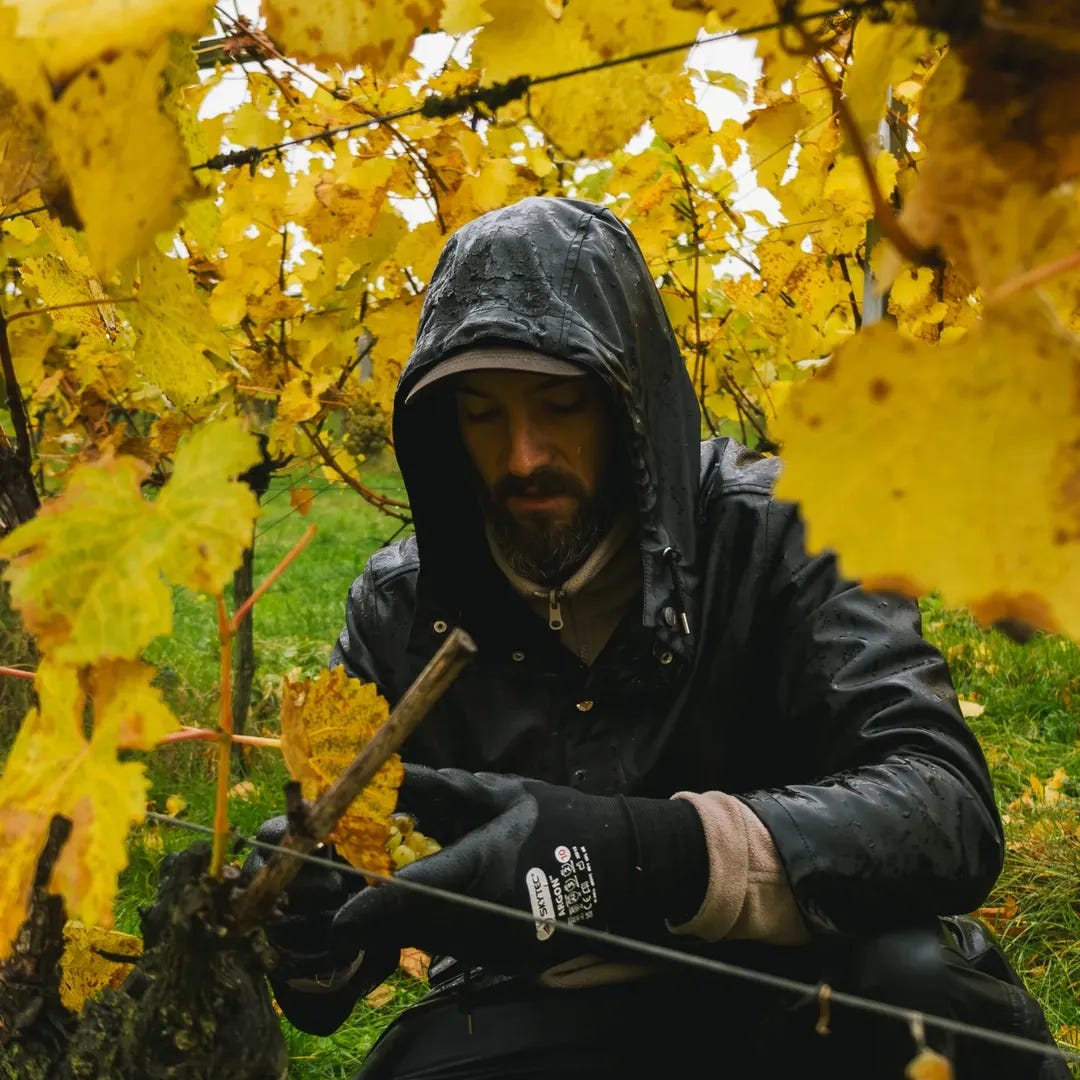
Adam: It’s about 15%.1 We only work organically, but then we’re very small. I can do everything by hand.
Hugh: Does that mean the vineyards you use are organic or organically certified?
Adam: I don’t believe in certification. I don’t like paying for someone to come and tick a box. And it’s more money again. I’m big on the most biodiversity you can have, the more biodiversity, the healthier your vineyard. You actually get less problems with mildews and insects when you’ve got a greater level of biodiversity. If you can plant plants that attract predator insects, that eat the bad insects, there’s a natural… [balance].
David: How many bottles do you make?
Adam: I normally make around 6–8,000, but last year I got enough to make about 12,000.
David: Similar to us, we make about 12. We’ve got new wines that’ll take us to 15-20,000 depending on the harvest. There’s no point doing loads and loads if the market’s not out there. It’s still an immature industry but in 20 years’ time it’ll be different.
Hugh: Talking about raising the profile, what should be done? Last time we spoke, David, you were talking about how we might link up all these vineyards in the South West, whether with a tour bus or something.
David: It’s almost impossible in the South West. They’re too diverse and spread out. And as I said to someone the other day, I can’t think of anything more boring than going to see five vineyards in a day. Once you’ve seen a vineyard, and – no disrespect – once you’ve seen a winery, you’ve seen a winery.
Hugh: Even the ones in Somerset are fairly far apart.
David: The thing is that we all have to latch onto something else, like other food and drink here in Frome or wherever, so that you’re part of a community.
Hugh: The other thing is, you both have got a very different story. But do you think that vineyards and winemakers across the South West produce enough character, enough difference in flavour, for people like me – who’re not so au fait in wine – to notice?
Adam [pouring three glasses]: This is pinot noir, but with 36 days contact. I’m not afraid of the colour, and I think you’re essentially getting more flavour in the aroma compounds extracted.
Hugh: [sips]: Strawberry?
Adam: Strawberry, raspberry, which I quite like. To answer your question, there are different people doing it in different ways in Somerset. Limeburn Hill in Chew Magna – they’re probably the most representative of Demeter in the whole UK. Demeter being the governing body of biodynamics.
David: Somerset is a big county. It’s got different soils and all the rest of it, and that in itself is going to produce different grapes off different locations. I mean, even though you and I are 30 minutes apart, the juice will taste different. It’s back to that geography.
Adam: There’s this really cool map I found recently that lays out the age of all the different borders and soils that have happened over the years to create different formations under the earth underneath. It’s the magic of wine, because there’s such difference in wine – so much complexity versus a beer or a cider.
Hugh: So all those things, what do they add up to? If you were to give someone not massively educated on wine an elevator pitch about how your wine tastes more like this and David’s wine tastes more like that, what would you say?
Adam: Here’s the thing – I’m running a little art and wine fair, because I used to be in arts before I got into wine full time. For me, there’s a big crossover between wine making and producing a piece of art. You’re affected by your surroundings. It’s about your touch – every stroke, every decision you make. It’s what you’re creating, and how that has an impact on someone.
Hugh: When two people have exactly the same materials, but what they create is always going to be different. Would I be right in saying your grapes, Adam, have quite a bit of skin contact, and the flavour that that produces is quite funky?
Adam: I would argue against that.
Hugh: Funky, I mean, in a good way.
Adam: I would argue we’re very clean.
Hugh: This is my lack of reference point, I think. Because the first one you poured [solaris and bacchus] reminded me of lambic beer — in a similar way to lambic you use spontaneous fermentation instead of using yeast made in a lab or whatever. To me that’s what gives that funk. Maybe ‘funk’ is not the right word,2 but the flavour profile is up and down and unpredictable and complex, whereas generally a lab yeast will produce something much flatter, no?
Adam: Well, yeasts are developed to promote certain aromas and flavours. I like to let the wild yeast do its thing. Because in my mind, whether it be true or not, it allows the grape and the vineyard to have a bit more of its own identity.
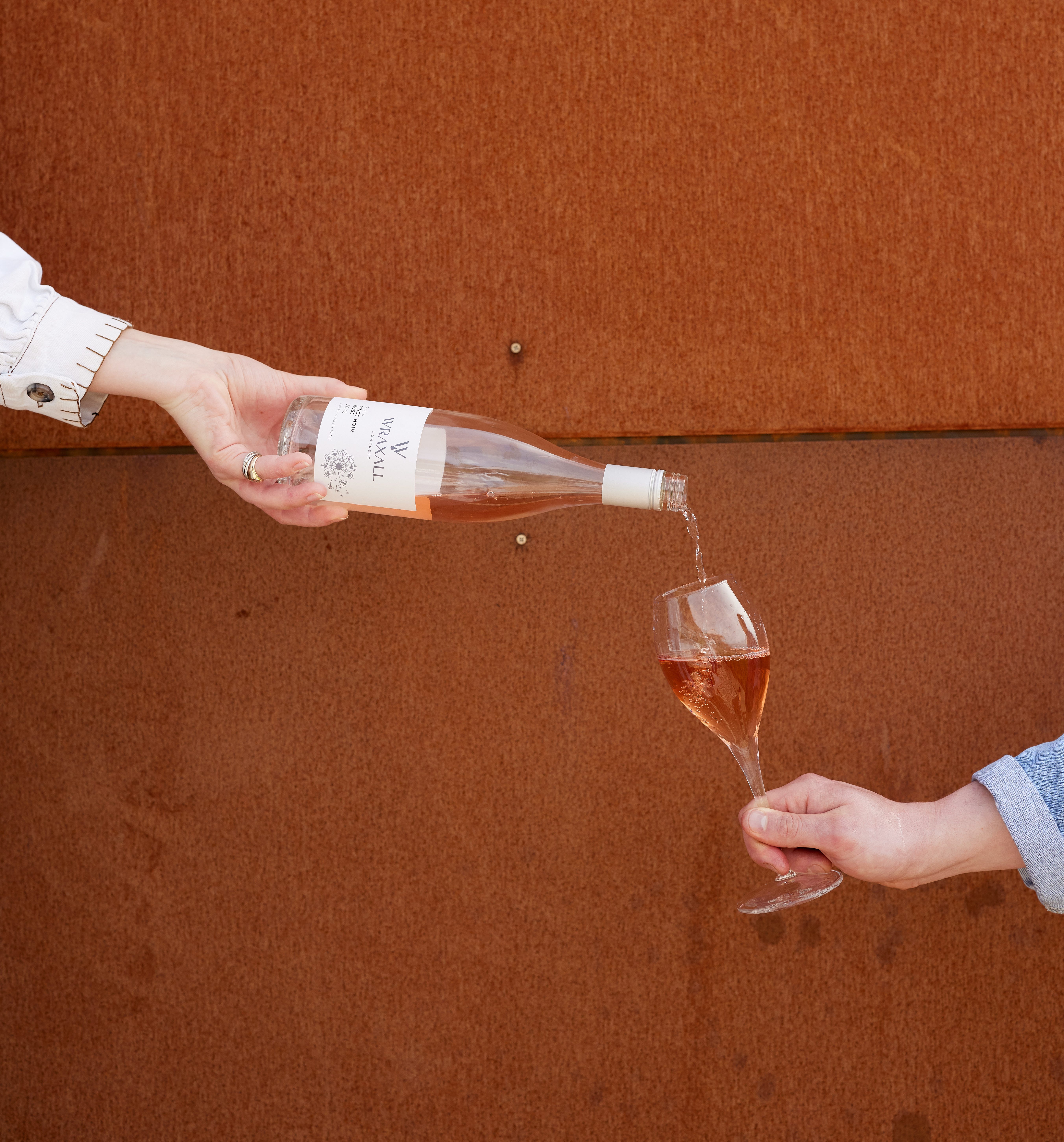
David: Whereas our drinkers want consistency. They want to be able to come up to the vineyard and have our rosé, because they liked last year’s rosé, and they want to like this year’s rosé, and they want it there or thereabouts. So if you buy a bottle of [Whispering] Angel or whatever it is, they’re producing X million bottles a year and they’re all the same, because people buy the brand and the name and they like it. So there’s two ways of buying things, isn’t there? You’ll buy something and it doesn’t matter whether it’s baked beans or whatever else – you’ll buy Heinz baked beans because you like Heinz baked beans, but then one day you might go, well, maybe I’ll have a bit of an experiment.
Adam: I find [my drinkers] want consistency, but they’re more open if it’s a little different. Because they’ll buy into that nature’s different. We should be buying a reflection of what happens rather than forcing something to be natural.
David: Exactly. The grapes are natural. The harvest is a natural thing. It’s a reflection on the year and the weather and what’s happened.
Adam: When I was abroad, I used a contract winemaker. They had just started out then. And I said to them I use wild fermentation, and they were really uncomfortable with it. And I’m like, no, this is a part of me – it’s what I do as a winemaker and a brand. There’s a chance with wild yeasts of off flavours or aromas. I’m fine with that risk, but they were heavily against it. Long story short, it was arguments all the way. They didn’t want to do any of it. And then when the wine was finished, they had a bunch of new PR people come in [to represent them] and they said, “Oh, do you mind if we use your baccus as the showcase of the baccus for the winery?” And they were showing it off as what they can do in wine and now they do that with loads of people.
Hugh: Is that because at the time there were so few winemakers using wild fermentation?
Adam: A lot of people who’ve been trained at a university have gone to work in big, big winery production for cheap supermarket wines. When you then have someone who comes along and goes, “Well, I don’t want to do any of that. We’ll rip up the rulebook and do it in a wild way with the yeast and we don’t know [how it’ll turn out],” they shit themselves. Making wine is an art. But so many people are trying to make it into a science.
Hugh: Maybe we can touch on the future of UK wine. I mean, we mentioned climate, and other things, but…
David: The future of English wine is very exciting. Thanks to climate, people understanding it, and these experiences we talked about. The industry itself is still really immature. It’s got a long way to develop, but it’s maturing really quickly.
Adam: It’s emerging because we can get naturally high acidity. When you make wine in another country, you have to adjust, adding a lot of tartaric acid and things like that. We naturally are getting to a point where we’re getting more consistent, high quality grapes like chardonnays and pinots that people really want. I think we’ve got our own character with bacchus grapes, and we should retain some of that character. But the main barrier is price – it’s been really hard for me to keep going because of how expensive it is.
Hugh: So there’s a bit of a reputation for UK wines like yours outside the country? Despite what it costs?
Adam: I was just in Italy for a month, visiting producers. I took my wines with me for them to try. Sometimes they were like, “Oh, English wine.” And then they tried it: “Wow, that’s actually really interesting.” So there was a level of respect and delight that the English can make interesting wines. There’s a buzz for a reason.
Other estimates suggest 8-10% of the UK’s total vineyard area is organically-accredited
Another way to put it would’ve been ‘farmhouse-y’ or ‘complex and acidic’ or something
Great to read about some representation of some of the much smaller producers in England. I think the 'English Wine Scenario' is quite an unusual one - probably the fastest country to have gone from vines in the ground to PDO classification (Sussex) and yet almost all the focus is directed on mirroring a style of wine that is increasingly unsustainable (see champagne glysphosate use). The 'big' names are saying the small producers won't last despite the fact the big producers rarely seem to draw a profit...
On top of that, many established, large producers in Europe have grown slowly from small agricultural projects that slowly amass functioning vineyards as they grow where English producers start with huge land investment that they get contractors to manage/prune (fuelling further glyphosate use already mentioned)
I think we all quite like our national identities, certainly our Welsh neighbours are great at promoting their distinct identity. That being said, the organisation that represents us all is called WineGB for a reason :-)